“My kids went to the local Madrassa for one year and they just learned the Arabic letters. Alhamdulillah now, they've been with Online Quran Tuition for one year, and they are able to read the Quran and they are moving forward. I appreciate your efforts. I would also like to thank Miss Sadiqi for all her hard work. Jazāk Allāhu Khayran.”
One-to-one teaching · Established 2012
How We Teach Quran Online
Every learner starts from a different place. Our job is to understand that starting point, match the learner with a suitable teacher and build a clear lesson route through Quran reading, Tajweed, memorisation or Islamic studies.
- Private live lessons
- Male and female teachers
- Regular progress feedback
Meet the teacher through three free trial lessons before choosing a monthly plan.
Free trial
3 free trial lessons
Meet your teacher and try the course before you pay anything.
No card required
No long-term contract
Teacher matching subject to availability
What this page covers
1. Tell us about the learner
2. Meet a suitable teacher
3. Use the free trial properly
4. Continue with an individual plan
Roles and qualifications
1
Student per lesson
600+
Students learning
2012
Established
The lesson journey
A clear process from first meeting to steady progress
The trial is used to understand the learner rather than placing everybody into the same starting lesson.
1. Tell us about the learner
Share the learner's age, current reading level, goals, teacher preference and several suitable lesson times. This gives the team enough information to begin a sensible match.
2. Meet a suitable teacher
The academy matches the request against the roles, qualifications, teaching experience and current availability of its teachers. Families may request a male or female teacher.
3. Use the free trial properly
During three free lessons, the teacher observes the learner's reading and response to correction. The family can assess communication, pace and whether the timetable works.
4. Continue with an individual plan
If the match is suitable, lessons continue one to one. The teacher focuses on the next useful skill and adjusts the pace around progress rather than a group schedule.
Teacher standards
Qualified teaching with academy oversight
A good Quran teacher needs subject knowledge, clear recitation and the ability to explain and correct with patience.

Roles and qualifications
The teaching team includes people with relevant roles and qualifications such as Imam, Qari, Hafiz, Alim and Alima. The applicable background depends on the individual teacher and the course being taught.
Selection and observation
Teacher selection considers Quran knowledge, recitation, communication and teaching ability. Supervisors monitor teaching as part of the academy setup so support is available when a lesson plan or teacher match needs review.
A match that can be reviewed
A teacher may be qualified and still not be the best fit for every learner. Families can raise concerns with the academy and ask for the match or timetable to be reviewed, subject to availability.
Inside each lesson
Teaching that responds to what the student does
Live correction is the main difference between a taught lesson and simply watching a recording.
Listen first
The teacher listens to the learner read or recite, identifies the specific difficulty and chooses the next correction. Beginners can start with Arabic letters and Noorani Qaida rather than being rushed into unfamiliar text.
Explain and demonstrate
The teacher models pronunciation, explains a rule in age-appropriate language and uses screen sharing or a digital whiteboard where it helps the learner follow the material.
Practise and check
The learner repeats the new skill while the teacher corrects in real time. Familiar material is revisited so the lesson checks retention as well as first-time performance.
Plan the next step
The next lesson follows from demonstrated progress. A Hifz learner may need more revision, while a reading learner may need focused work on letter recognition, fluency or Tajweed.
Parents and progress
Keep families informed and involved
Parents should know what their child is learning and where support is needed.
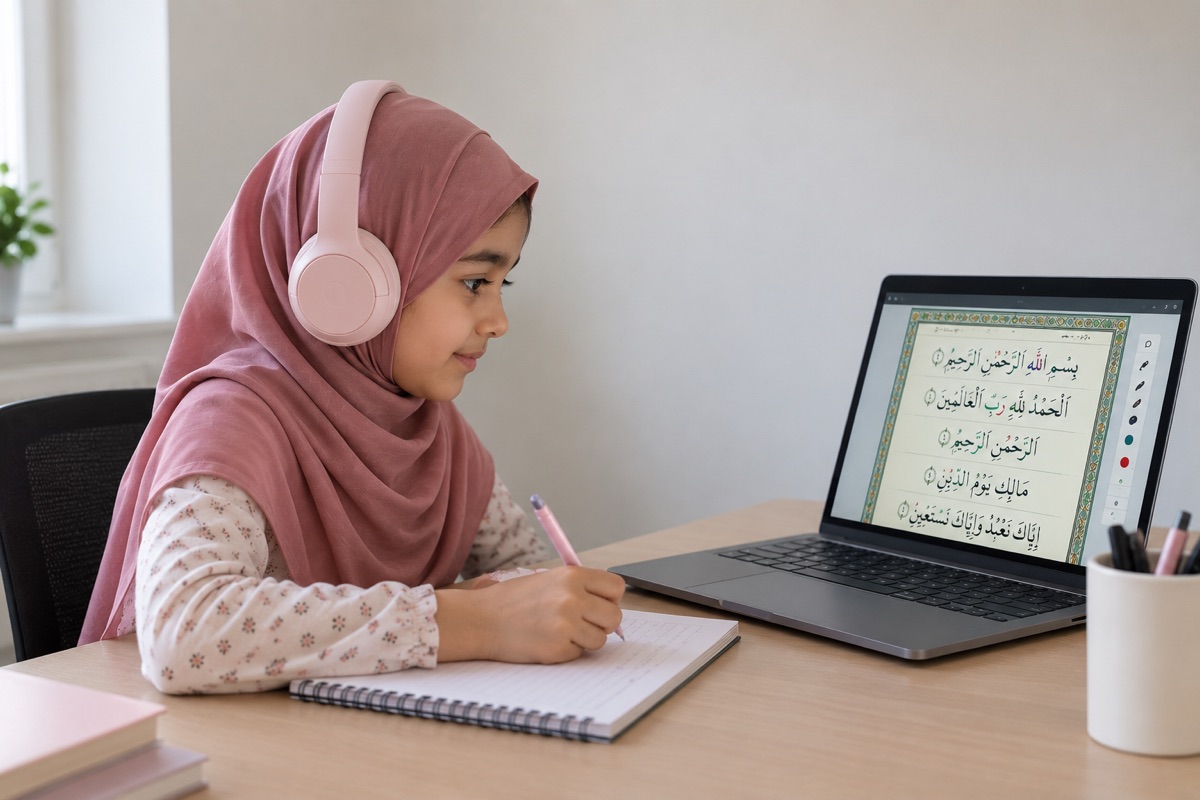
Clear communication around the learner
Parents receive progress feedback so they can see what has been covered and what comes next. Families can also tell the academy when a child is struggling, a schedule has become difficult or the teacher match needs attention.
For younger children, an adult should help create a quiet lesson space, make sure the device is ready and remain appropriately involved. The academy should be contacted directly about attendance, timetable or teaching concerns rather than leaving a child to manage them alone.
Learning pathways
Choose the course that matches the goal
The teaching process stays personal, but the curriculum changes with the learner's objective.
Quran reading
Begin with Noorani Qaida or continue with guided Quran reading lessons.
Tajweed
Use one-to-one Tajweed lessons for live pronunciation correction and practical application of recitation rules.
Memorisation
Follow an online Hifz programme that balances new memorisation with regular revision.
Islamic studies
Add online Islamic studies for age-graded learning in Islamic knowledge and practice.
What parents & students say
Trusted by Families Across the UK
“Assalaamu alaikum — it was getting difficult for me to take my children to the Mosque every day because of my job. My children have been learning with Online Quran Tuition for 12 months now and I am very satisfied with their progress. They are getting Islamic knowledge faster than other children of a similar age. Jazak Allah.”
“I have had a few Tajweed lessons with Online Quran Tuition and Alhamdulillah I have learnt a lot in these few sessions. With their help I hope it won't be too long before I can read the Qur'an with proper Tajweed InshaaAllah. Thank you for your patience. Jazak Allah.”
Teaching questions
How Online Quran Lessons Work
Yes. Lessons are private and live, with one learner and one teacher, so correction and pace can be adapted to that student.
Yes. Families and adult learners can request a female or male teacher. The team confirms the match against current availability.
The teacher observes what the learner can recognise and read during the trial lessons. A complete beginner can start with Arabic letters and Noorani Qaida, while an existing reader can focus on fluency or Tajweed.
Supervisors monitor teaching within the academy setup. Families can contact the academy when a lesson plan, timetable or teacher match needs to be reviewed.
Yes. Parents receive progress feedback so they can understand what has been covered, where the child needs support and what the next learning step is.
The family decides whether to continue. If the match is suitable, they choose a monthly plan. There is no card requirement for the trial and no long-term contract.
Meet the teacher before
you choose a plan
Share the learner's starting point, goals and suitable times. Use the three free lessons to assess the teacher, pace and learning experience.
No card required · No long-term contract · Matching subject to availability