



Online Quran Tuition
3 Free LessonsStart Free Trial

Every learner has a starting point

Quran Learning
Case Studies

Follow four different learning journeys, from first letters to memorisation. See the questions parents asked, what the trials revealed and the next steps they chose.

3 free trial lessons · Meet the teacher before you decide

Different starting points

Finding the right next step

Each family put different questions first. Read the starting point, what the parent noticed in the trial, and what still needed work.

Portrait illustrating Aisha

Case 01

Aisha, age 6

Complete beginner

“Can I do the letters again tomorrow?”Learner’s words

Starting point

She knows a few Arabic letters from a picture book but can't yet read joined letters.

What the parent did next

The only low score was practice. She asked the teacher for a specific home task and was given five minutes a day on that week's letters.

The takeawayFor a young beginner, comfort and short, clear practice mattered more than speed.

Quran lessons for children · Read how to help a young child start reading the Quran.

Profile, trial scorecard and monthly tracker

Profile

Aisha has never had Quran lessons. Her mother works part-time and can only manage weekday lessons after 5pm. The family would like a female teacher.

Questions the parent put first

  • How will the teacher assess my child in the first lesson?
  • Can we request a female teacher, and keep the same teacher if the match works?
  • How long are lessons, and is that suitable for a six-year-old?
  • What practice is realistic between lessons?

Trial 2 of 3

Trial lesson scorecard. Scores out of 5.
AreaScoreNotes / example
Teacher explained clearly5Used letter shapes and sounds, one at a time
Child felt comfortable4Shy at the start, smiling by the end
Lesson started on time5
Corrections were gentle5Repeated the sound with her rather than saying "wrong"
Next practice was clear3Not sure how many minutes a day to practise
Timetable works for us55:30pm slot fits after school
Provider was easy to contact4Replied the same day

Monthly tracker: month 2

Reading focus
Individual letters and their sounds; beginning to recognise letter shapes at the start of a word.
Still difficult
Similar-looking letters that differ only by dots.
Teacher's next goal
Confident recognition of the dotted letter groups before moving on.
Parent notes
Practice works best before dinner, not before bed.
Portrait illustrating Yusuf

Case 02

Yusuf, age 9

Reads but needs Tajweed support

“She noticed things my old class didn't.”Learner’s words

Starting point

He can read from the Mushaf with some hesitation. Several Tajweed rules are not applied consistently.

What the parent did next

The teaching scores were strong but the timetable didn't work, so the parent asked about other slots before deciding. This is a practical problem, not a teaching one, and is worth solving before paying.

The takeawayA learner who already reads may need targeted correction more than new material. The scorecard helped the parent separate a teaching question from a scheduling one.

Online Tajweed classes · Read how to improve Tajweed when your child already reads.

Profile, trial scorecard and monthly tracker

Profile

Yusuf attended a local evening class for two years. His parents are comparing that class with one-to-one online lessons because he reads quickly but makes repeated pronunciation mistakes.

Questions the parent put first

  • Are lessons individual or group-based, and how long are they?
  • What is the next useful reading or Tajweed goal?
  • How will the teacher explain progress and what still needs work?
  • How are absences, late lessons and timetable changes handled?

Trial 1 of 3

Trial lesson scorecard. Scores out of 5.
AreaScoreNotes / example
Teacher explained clearly5Named the rule and showed it in the verse he was reading
Child felt comfortable4
Lesson started on time4Two minutes late; teacher said why
Corrections were gentle4
Next practice was clear5Three lines to read aloud, focusing on one rule
Timetable works for us2Clashes with football on Wednesdays
Provider was easy to contact4

Monthly tracker: month 1

Tajweed focus
One rule at a time, practised in the verses he already reads.
Correction to practise
Slowing down at the points where the rule applies.
Still difficult
Keeping the rule when reading at his usual speed.
Parent notes
He prefers being corrected one-to-one rather than in front of a group.
Portrait illustrating Maryam

Case 03

Maryam, age 11

Memorisation and revision

“I knew it at home but got nervous.”Learner’s words

Starting point

She has memorised several short surahs, but forgets earlier ones when she moves on.

What the parent did next

Most scores were high, but the two low ones were about comfort. As the pack says, a concern about your child's comfort needs attention even when other scores are high. The parent contacted the provider and asked to discuss a different teacher for the next trial lesson. The second teacher started each lesson with revision before new lines.

The takeawayStrong scores in most areas do not outweigh a child feeling uncomfortable. Changing the match early protected her confidence.

Quran memorisation course · Read how to help your child memorise and revise.

Profile, trial scorecard and monthly tracker

Profile

Maryam is memorising short surahs from the last part of the Quran. Her parents want steady memorisation without losing what she has already learned.

Questions the parent put first

  • For memorisation, how is revision balanced with new learning?
  • What feedback will parents receive, and how often?
  • Can we discuss a different teacher if the trial match is unsuitable?

Trial 1 of 3

Trial lesson scorecard. Scores out of 5.
AreaScoreNotes / example
Teacher explained clearly4
Child felt comfortable2Said she felt rushed
Lesson started on time5
Corrections were gentle2Several corrections in quick succession
Next practice was clear4
Timetable works for us5
Provider was easy to contact5

Monthly tracker: month 2

Memorisation
New lines added gradually.
Revision
Earlier surahs recited at the start of each lesson.
Still difficult
Two surahs with similar openings get mixed up.
Child's perspective
Feels calmer when revision comes first.
Portrait illustrating Ibrahim

Case 04

Ibrahim, age 8

A shy learner who wants to understand his deen

“I like it when Dad sits in the room.”Learner’s words

Starting point

He has finished the early stages of reading but loses confidence when asked to read aloud.

What the parent did next

A parent stayed nearby for every lesson, as the NSPCC tutoring guidance recommends. They agreed that all messages would go through the parent, and noted who to contact with a concern.

The takeawayFor a shy learner, the safety and communication questions also built trust. Agreeing contact arrangements early helped the parent feel involved.

Online Islamic studies · Read how to choose a Quran teacher for your child.

Profile, trial scorecard and monthly tracker

Profile

Ibrahim speaks English at school and some Urdu at home. He is quiet with new adults. His parents want him to read the Quran and also understand the basics of practice, such as wudu and salah.

Questions the parent put first

  • Can the teacher explain in a language my child understands?
  • How can a parent observe or remain nearby during lessons?
  • Will communication outside lessons go through the parent?
  • Who handles a concern, and how do I contact them?
  • Is learning about the deen, such as wudu and salah, part of lessons?

Trial 3 of 3

Trial lesson scorecard. Scores out of 5.
AreaScoreNotes / example
Teacher explained clearly5Explained in English, with Urdu where it helped
Child felt comfortable4Answered more by the third trial
Lesson started on time5
Corrections were gentle5
Next practice was clear4
Timetable works for us4
Provider was easy to contact5Messages came to the parent, not the child

Monthly tracker: month 3

Reading focus
Reading aloud short passages with the teacher.
Islamic learning
The steps of wudu, practised at home before salah.
Still difficult
Reading aloud without long pauses.
Parent notes
Confidence is better when he is praised for effort, not only accuracy.

What the cases have in common

Listen to the child.
Keep asking questions.

  • The first lesson is an assessment, not a test.Each teacher started from where the learner actually was.
  • Low scores start a conversation.Timetable clashes, unclear practice and comfort concerns were each raised before paying.
  • Changing the match is normal.It's a reasonable request during the trial, not a complaint.
  • Record what is still difficult.Each tracker entry names a difficulty, not just progress.
  • Progress is individual.It depends on starting level, attendance, practice and individual needs.
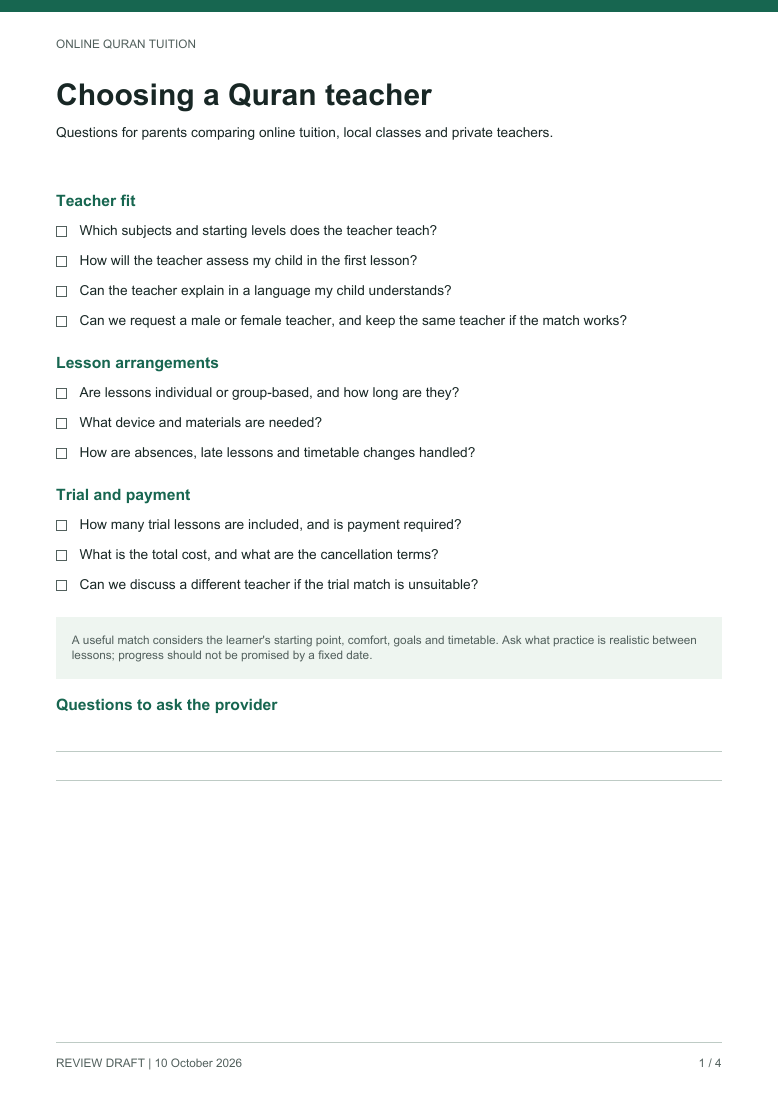
First page of the printable parent checklist

Take the questions into your trial

Your printable parent pack

Four A4 pages to help you compare options, reflect on each trial lesson and keep track of learning.

  • Teacher selection and parent involvement checklist
  • Trial lesson scorecard with space for notes
  • Reusable monthly progress tracker
Download printable pack (PDF)

Meet the teacher before you decide

Start with three free trial lessons

Use the trial to ask questions, see how your child feels and discuss the next learning goal.

Start 3 free lessons